Knowing about digital marketing isn’t just an option – it’s essential for nearly any job or company. In 2026, most people will begin shopping online, maybe typing into Google or scrolling through videos on YouTube and Instagram. Because of this shift, getting good at digital tools could be one of the best choices you make professionally.
If you’re looking to build real-world skills, enrolling in structured digital marketing courses can help you learn faster with guided expertise and hands-on projects.
Buyers now know more, stay linked up constantly, yet pick what they want far more carefully than in past years. Most firms must show up where it counts, when it matters – message sharp and clear. Data guides the path, creativity adds flavor, while fresh web tools open doors. Reaching the correct people begins with spotting them first. Getting attention follows, then shaping choices step by step across every stage of purchase. Digital marketing makes this flow possible.
If you are a student considering your future career or a working professional seeking career advancement, digital marketing is the place to be. It’s not just about placing ads or posting on Facebook. It covers a broad variety of categories including SEO, content marketing, social media marketing, email marketing, paid advertising, analytics and marketing automation. All of which have a role to play in creating brand awareness, driving traffic, generating leads and boosting revenue.
This ultimate guide will help make sense of digital marketing, allow you to teach yourself the basics, and learn from the ground up. You will discover what digital marketing is in the modern age, how the various channels complement each other, and why it is a must-have for every business today.
What is Digital Marketing ?
Digital marketing is the promotion of products or services through one or more forms of electronic media and it has a very wide reach which supports in spreading information more easily and even updates about a product could be sent to the masses easily.
In the last decade, this has included ranking on Google Search to attract fans on Instagram, LinkedIn, You-tube. It is a sophisticated craft that combines analysis, content, and strategic planning to transform the path customers take – the ways people search for, assess, and purchase products on the internet – and, consequently, how business entities manage and augment today’s underpinnings of commerce. In contrast to conventional marketing tactics, digital marketing provides businesses with an opportunity to connect with their customers at the right place and right time, serve them directly and monitor results in real-time.
Thanks to data, the campaigns can be optimized in real time, the marketing is more efficient and has better results. Put simply, digital marketing is the act of utilizing internet and online-based digital technologies to communicate with customers, develop relationships and drive quantifiable business growth.
Why Digital Marketing Is Important in 2026 ?
Consumers today have more information and are more digitally connected than ever. Most people today begin their research on a product or service on Google Search before making a purchase, they compare products on various websites, read reviews and testimonials and track brands on social media such as Instagram or You-tube.
This change in consumer behavior has completely changed how businesses get customers. People don’t just rely on ads; They trust the information, they trust the online opinions of their own peers and they value the engagements that they have with brands online. And this shift makes digital marketing necessary for every business, big or small. It enables brands to maintain visibility in a crowded market where people have little time on their hands and a lot of competition to distract them. Rather than sending out broad messages to everyone, companies can deliver their messages to audiences that are segmented by interests, behaviors and intent. More significantly, digital marketing delivers clear, quantifiable results.
Digital Marketing Basics: Core Channels You Must Know
In order to get successful in digital marketing, you need to have an understanding of its fundamental channels and how they operate together. Each channel has a different role in drawing, entertaining and transition customers at different stages of the buyer journey. These channels aren’t isolated when leveraged properly. They work together to build a unified, successful marketing system.
1. Search Engine Optimization (SEO)
Search Engine Optimization or SEO, is the practice of increasing your website visibility in search engines like Google Search. When people look for something to buy, service or information. SEO helps your website appear higher in those search engine results bringing more chances of clicks and traffic.
When it comes to technical aspects of SEO, there are a few things you can do to optimize your site for search engines. It also consists of creating backlinks and improving the user experience. SEO is a long term strategy that depends on organic traffic, i.e. visitors who get on your website naturally and not on account of paid advertising. So do all that and it still allows you to attain authority, credibility and sustainable growth for your brand.
2. Content Marketing
Content marketing is a marketing technique of producing and distributing valuable, relevant and consistent online content (e.g. videos, blogs, posts on social media) without explicitly promoting a brand in order to attract and retain a clearly defined audience – and ultimately drive profitable customer action. This method is not to serve led products and services but helpful information that addresses customer’s problems or inquiry. Content can exist in many forms, such as blog posts, videos, infographics, case studies, guides, and even social media updates.
Great content doesn’t just bring traffic – it will help with SEO and it will nurture potential customers along their journey. The objective is to educate, inform and develop trust which will ultimately result in better engagement and conversions.
3. Social Media Marketing
Social media marketing is the use of social media platforms like Instagram, LinkedIn and YouTube to promote your brand and connect with your audience. Especially for professionals and B2B businesses, mastering LinkedIn can be a game-changer. A specialized LinkedIn lead generation course can help you convert connections into high-quality business opportunities.
Executives at companies say they have high hopes for social media content, which they use to share content, run campaigns, talk to followers and create communities around their brands.
Read more: SEO vs Social Media Marketing career
4. Pay-Per-Click Advertising (PPC)
Pay-Per-Click (PPC) is a paid marketing model where advertisers pay money to the publisher when their ad is clicked. And now on with its advertising capabilities, you can be able to target users by keywords, and by demographics, and interests.
Unlike SEO, which takes a while to have its results, PPC provides immediate visibility and traffic. It is particularly useful for product launches, seasonal campaigns and for lead generation. With the right optimization, PPC ads can offer a positive return on investment by reaching very specific audiences.
5. Email Marketing
Email marketing refers to the use of email to promote products or services to a list of users who have opted in to receive information related to the business. However, it’s still an excellent channel for one-on-one communication and engagement.
Now it is the tool of choice for communication within both the business and consumer worlds. Engaged users can be converted through personalization based on their knowledge and preferences. Product/Correctly done, email marketing may yield excellent ROI and reasonable levels of customer loyalty.
6. Affiliate and Influencer Marketing
Affiliate and influencer marketing revolve around using third parties to advertise your goods or services. In affiliate marketing, partners receive a commission when they make a sale or a lead. In influencer marketing people with large online followings promote products to their fans on the likes of Instagram and YouTube.
This allows brands to grow their visibility and gain credibility more quickly by lending audiences already built. It is particularly good for brand awareness, traffic generation and impacting purchasing decisions through trusted voices.
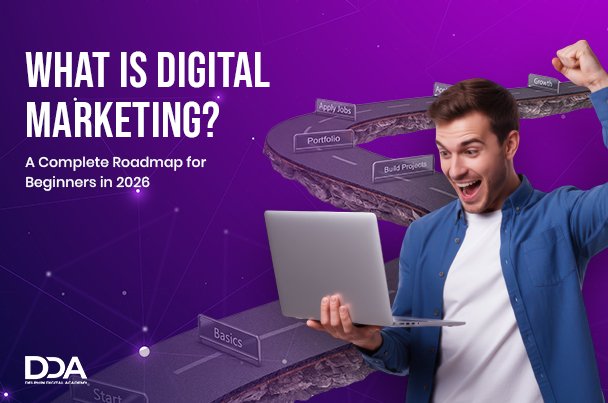
Roadmap to Digital Marketing for Beginners (2026)
Even if you are planning to take digital marketing course, a roadmap allows you to keep the learning process more purposeful and effective! It can be an intimidate at first with the variety of digital marketing courses available in online but if you split the process in simple roadmap steps, you can acquire your skills step by step and with confidence.
Step 1: Understand the basics
Start with the basics of how digital marketing operate as an industry. Understand the basics of SEO, content marketing and social media. Learn how the various channels work together to complement each other to lead generation and traffic. Here, resist the urge to rush into tools or platforms. Develop a solid conceptual foundation so that all of your later learning makes sense in context.
Step 2: Learn SEO Step by Step
SEO is one of the most valuable and fundamental skills in digital marketing. Begin with knowledge of how search engines, such as Google Search, work and how websites are ranked.
Concentrate on issues including keyword research, on-page optimization and technical SEO basics (such as site speed and mobile-friendliness) – as well as link building. Don’t just study the theory, put what you learn to work by running your own blog or website. This first exercise in practical work will also help you see how rankings improve over time.
Step 3: Build Skills in Creating Content
Right in the middle of every digital move sits content. From search engines to posts online or messages sent out, good content pulls people in while slowly creating confidence. Start by making blog posts that grab attention, then move to social updates that pull readers in – using clear ideas helps. Instead of pushing what you sell, try showing something helpful instead.
Picture someone asking a question; give them an answer they can actually use. Simple visuals work well when they explain things fast. Stay focused on what matters to the reader, because confusion pushes people away.
Step 4: Select One Channel to Focus On
Most new people jump into too many things right away. Pick something small instead, maybe SEO or writing posts online. Focus can mean trying just Instagram for now, or sticking with LinkedIn articles every week. Learning feels easier that way.
One path at a time builds real understanding, plus steady progress feels more natural. Begin here: when things click and effort leads somewhere, stay put awhile. Only after momentum forms does exploring new angles make sense – each skill connects once the first holds firm.
Step 5: Learn paid advertising
Getting noticed fast often means paying to show up where people look. Picture your message popping up just when someone searches for what you offer. Spending money on ads can speed things up instead of waiting around.
Different tools let you decide who sees your words based on habits, location, or interests. You set limits so costs stay under control even when clicks add up. Bids shift depending on how hard others compete for attention too. Watching numbers helps figure out what works and what drags behind. Each click tells a small story about choices made earlier.
Step 6: Build actual projects
Out there, doing things matters most. Jump into hands-on work to test what you know. Try building a personal blog from scratch. A focused Instagram profile could be next. Freelance gigs offer another path forward. When you dive into real tasks, hurdles become clear. Trying different approaches lets you learn what works. A collection of finished work shows others how well you can perform. Employers notice when they see proof instead of promises.
This is exactly why structured training plays a key role and here’s a deeper look at how digital marketing training builds job readiness and prepares you for real-world roles.
Step 7: Learn analytics and optimization
Numbers shape digital marketing, because guesses won’t cut it. Discover ways to assess what works through clear insights from analysis software. Tools such as Google Analytics show where visitors go, how long they stay, plus which parts of a campaign actually connect.
What really matters? Getting clear on numbers like visits, interactions, and how many people take action. Good marketers spot patterns in data – weak ones miss them. Watch progress build when choices come from insight instead of guesswork.
Digital Marketing Tools You Should Know
Selecting the right tool or tools can make all the difference in how productive, efficient, and effective your marketing efforts are. Digital marketing isn’t just about strategy and creativity. It just so happens to be heavily reliant on tools which allow you to research, execute, analyze and optimize your campaigns.
For SEO, it is common to use tools like Google Search Console, SEMrush and Ahrefs to analyze the website, monitor site performance, find keyword opportunities, check backlinks, and conduct site audits.
For analytics, you can use Google Analytics to find out what your users are up to on your website, where is your traffic coming from, and which of your campaigns are working. When it comes to content creators, Canva is one of the best options for crafting social media posts, presentations, and marketing creative without needing prior design experience.
Mailchimp – The popular choice for email marketing. Create, automate and track email campaigns Mailchimp has emerged as one of the most popular solutions for email marketing.
Furthermore, social media management services such as Hootsuite and Buffer enable you to schedule posts and monitor multiple accounts from the convenience of your own dashboard.
These are the tools that allow you to save a lot of time, be consistent and focus on the strategy, content and not on so much manual execution. Your knowledge of these tools and your ability to use them effectively will give you a strong competitive advantage as you advance in the field of digital marketing.
Digital Marketing Career 2026
Digital marketing is undoubtedly the fastest growing and one of the most sought after career option in 2026 after the center of business is shifting to web space so fast. From startups to global enterprises, all companies are spending on digital platforms such as Google Search, Instagram, and LinkedIn to connect with and draw in their audiences.
That talent is divided into multiple channels, with demand for proficient marketers jumping in organic search, social media, and email marketing, among others. The demand for such professionals will increase even in future as companies prioritize digital-first strategies. Many training institutes also offer dedicated placement support, helping learners transition smoothly into real-world roles after completing their courses.
One the most appealing aspects of a digital marketing career is its easy access and latitude for success. You can work at a company full time, freelance, consult, or even launch your agency or personal brand. The industry values a combination of creativity and data analysis, so you are able to test out theories and ideas, but also making informed decisions based on the numbers.
FAQs
1. What is digital marketing?
Digital marketing is a means of advertising the sale of products or services by electronic medium like search engine, social media website, email and mobile applications. Through digital marketing methods, the companies are able to establish contact, interact and obtain conversions from the potential buyers, through sites like Google search, Instagram and YouTube.
2. Why is digital marketing very important?
Digital marketing is very important since today most buyers start their purchase on the digital medium. This makes marketing to be far more effective and data oriented in terms of reaching the potential buyers and managing its effectiveness more accurately through tracking of campaign and proper adjustments.
3. How to start digital marketing for beginners?
You may want to start by learning the key basics like SEO, content marketing and social media, if you are new to digital marketing. As soon as you get some knowledge on the key basics, you may also begin to learn by writing an article on your own blog or by managing and updating a social media profile, or by taking on small freelancing works so that you will be able to experience the whole working procedure.
4. What skills do I need to do digital marketing?
The essential skills you need are content creation, communication skills, basic SEO, data analysis skills, creativity and an understanding of marketing tools. Paid media skills, analytics and automation are more of an acquired skill.
5. How long does it take to learn digital marketing?
You can learn the basics in a couple of months if you apply yourself. To really master digital marketing though, you’re looking at anywhere between 6 and 12 months where you will have the opportunity to practice and apply skills.
6. Is digital marketing a good career to do in 2026?
Yes, digital marketing is a great career to be involved in, in 2026, as it is a high-demand field and you’ll be presented with countless flexible career paths and the potential for advancement as companies everywhere utilize online channels.
7. Do I need to code to be able to do digital marketing?
You do not need to have a coding ability to do digital marketing. While it is useful to know a little about HTML or website architecture if you want to get really good at website and search engine optimization tasks, this is not essential.